Why Yunnan Matters to the History of Tea
A starting point for understanding one of the world’s most complex tea regions.
Understanding Yunnan tea begins with history, but history is only the beginning. To understand what Yunnan tea means today, we also need to look at the landscapes where it grows, the people who make it, the processes that transform it, the science behind its composition, and the global systems through which it is traded and understood. That is where this journal begins.
1. The world knows the names, but not the whole story
Most tea drinkers encounter Yunnan through a name: Pu’er, Dianhong. Or perhaps Ancient tea. These names are familiar in the global tea trade, and they carry real weight. They point to places, practices, markets, and histories. But they can also obscure the larger reality they come from. A name is not a landscape. A category is not a full history.
The world knows that Pu’er exists, that Yunnan produces black tea, that ancient tea trees grow in the mountains of southwestern China. What the world often does not know is why Yunnan has mattered, and continues to matter, to the way tea is understood, traded, and imagined across the globe.
To understand tea, it is not enough to recognize the names. We need to look beneath them.

2. Yunnan is not simply another tea-producing region
It is tempting to treat Yunnan as one more origin on a long list: another province, another style, another supplier. That framing misses what makes Yunnan distinctive. Yunnan is not synonymous with Pu’er. The province produces green teas, black teas, white teas, and other styles. It contains ancient tea forests, terrace gardens, smallholder plots, and large-scale factories. It is home to many ethnic communities, each with distinct relationships to tea. It spans tropical valleys, subtropical hills, and high mountain zones.
To speak of Yunnan tea as one thing is to flatten a landscape. Yunnan is better understood as a tea landscape: a shifting mosaic of ecology, culture, agriculture, processing, and trade. Pu’er is one important expression of that landscape, not its boundary.
3. Tea in Yunnan has a history longer than today’s categories
Modern tea classification often divides tea into six classes based on processing: green, yellow, white, oolong, black, and dark. This framework is useful. It helps traders, students, and consumers communicate. But it is not natural law. It is a historical and practical system, shaped by trade, technology, and national industries.
Yunnan exposes the limits of that system. Pu’er is often classified as dark tea, yet the category does not comfortably contain the role of aging, or the local practices that produced it. Some Yunnan teas are sun-dried rather than fired, pressed rather than loose, aged rather than consumed fresh. Some local methods — roasting, bamboo storage, pickling, and fermentation — do not map neatly onto export categories. Even the word “fermentation” can mean different things in different contexts.
This is not a failure of Yunnan tea. It is a failure of any classification system to capture the full range of human practice. Yunnan reminds us that tea categories are tools, not truths. They help us see, but they also hide.

Yunnan’s tea history is also deeply connected to trade. For centuries, tea moved from Yunnan along caravan routes into Tibet, Southeast Asia, and other parts of China. These routes are often gathered under the name “Tea Horse Road,” though in reality they were multiple roads, paths, and networks, shaped by geography, politics, and demand. Compressed tea was practical for transport. Aging and fermentation were not merely accidents; they were responses to distance, climate, and market needs.
4. From tea trees to tea-making
Yunnan’s significance begins with the plant itself. The broader region of southwestern China and adjacent areas is widely regarded as a center of tea’s domestication and diversification. Genetic diversity among tea plants is high in this region, and Yunnan contains wild tea populations, ancient tea trees, and long-established cultivated varieties. The evidence is strong that this part of the world played a central role in the human story of tea.
But certainty has limits. The precise routes, timings, and mechanisms of tea’s domestication and spread remain areas of active research. Was there one center of origin, or several? How did human selection interact with natural hybridization? What was the relationship between wild tea, ancient trees, and cultivated gardens? These are not trivial questions. They require careful distinction between what is documented in historical records, what is observed in the field, what is interpreted from genetic and archaeological evidence, and what remains unresolved.

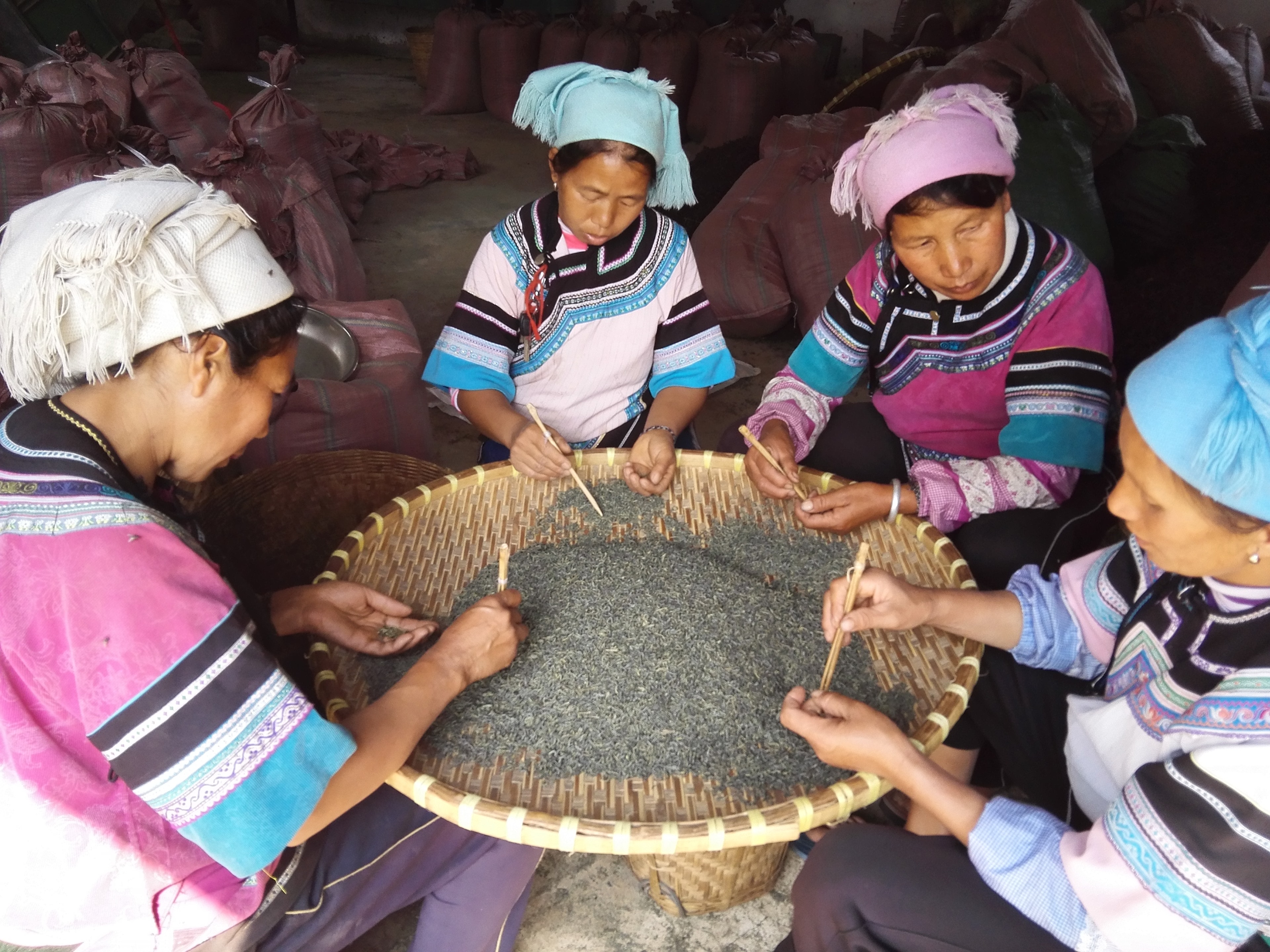
From the tree, the story moves to the making. In Yunnan, tea is not only a plant. It is a relationship. Many communities — including Bulang, Dai, Hani, Lahu, Wa, Yi, and others — have managed tea across generations. Their practices are ecological as well as agricultural. Tea grows in forests, on slopes, near villages, and in gardens that may look wild to an outsider but are shaped by human care and knowledge.
5. Why is Yunnan tea difficult to explain?
Yunnan tea is not difficult to explain because it lacks a story. It is difficult to explain because it contains too many stories at once.
There is the biological story: domestication, genetic diversity, wild populations, ancient trees. There is the ecological story: altitude, latitude, soil, climate, shade, and the slow adaptation of plants to place. There is the cultural story: ethnic communities, local knowledge, oral traditions, and the ways tea is woven into daily life. There is the craft story: sun-drying, pressing, roasting, bamboo storage, pile fermentation, and the many local methods that never fit neatly into export categories.
There is the scientific story: polyphenols, catechins, theanine, caffeine, volatile compounds, microbial communities, and the chemical transformations that turn leaf into tea. There is the trade story: caravan routes, Dianhong, global markets, collectors, investors, authenticity claims, and the pressures that simplify complex products for distant buyers. There is the category story: the six-class system, the debate over whether Pu’er belongs to dark tea, the tension between raw and ripe, the role of aging, and the fact that local practice often precedes and exceeds classification. And there is the research story: what is documented, what is observed, what is experienced, what is interpreted, and what remains unresolved.

6. This is why YunnanTea.com exists
Much of the most detailed knowledge about Yunnan tea exists in Chinese, and often in local languages or oral traditions. Some of it has been translated. Some has been summarized in promotional materials. Some has been romanticized, simplified, or repeated without verification. English remains the primary language of international trade, research, and journalism. Yet there is no single, reliable, independent English-language reference that treats Yunnan tea as a serious subject in its own right.
That gap matters. Without reliable information, international buyers rely on marketing. Researchers rely on scattered sources. Journalists repeat familiar narratives. And Yunnan itself is often reduced to a few famous names.
This is the context in which YunnanTea.com is being developed. Not as an official body. Not as a government project. Not as a trade association. But as an independent, editorially led knowledge platform dedicated to documenting Yunnan tea and explaining its global significance. Its purpose is not to promote Yunnan above other regions, but to make Yunnan intelligible to the world — and to make the world’s understanding of tea more accurate, more nuanced, and more useful.
Yunnan shows that tea is never only a beverage. It is a relationship between plants, people, landscapes, and markets, across time. To understand tea, we need to understand Yunnan. To understand Yunnan, we need careful, independent, accessible knowledge. That is the work YunnanTea.com intends to support.